Wake up with a Willy Wonka–world style brunch experience surrounded by disco balls, graffiti-covered walls, and fluorescent globe lighting, but you can’t make reservations on busy weekends or holidays when it’s all brunch all the time, so prepare to wait. Traditional omelettes and waffles are …
Celeb chefs Alvin Leung and Eric Chong of Master Chef Canada fame channel their childhood memories to bring an unparalleled 10-course tasting menu that fuses Asian flavors with traditional European techniques, in the most abstract and beautiful manner. Past molecular creations have included a crystalline …
It had been years since I’ve been back to PEC, and I knew a lot had changed since my last visit, so when I was invited to dinner at Littlejohn Farm for a collaborative dinner with Miku, Toronto’s aburi sushi destination, it only made sense to for Misha and I to make a weekend out of it.
Littlejohn Farm is known for their sustainable agriculture and culinary experiences where they teach people about sustainable food harvesting through wholesome, healthy, terroir-based gastronomy. Their goal is to connect people with a deeper understanding of food production and where its from.
The farm may be small, but Chef Zach and his wife/business partner Lu Littlejohn’s vision is mighty, and based on love. Love in the romantic sense but also love in the sense of kindness for animals and the environment.
As Luhana (Lu to friends) led us on a tour of their few hectares-sized farm, we learned some of their secrets to sustainability.
Their livestock are kept vegetarian, treated with kindness and compassion living multi-purpose lives (just like many of us in the gig economy.) Pigs are bred as flesh and blood composters, but kept on high nutrient diets for an optimal fat to protein ratio. Momma pig lives the fullest life as she is kept to breed while her babies live beautiful lives in comfort…. with only one bad day.
Same goes for the sheep. Male runts (or spares in livestock talk) are purchased from a commercial farm and let out to graze in the pasture, until they eventually have that one bad day.
Egg-laying chickens are kept on a grass diet, and if they’re happy, lay one brought orange-yolked egg a day.
Our local farm-to-table meets Japanese fusion meal was served in three parts
appetizers
mains
and desserts, of course!
with wine pairings scattered through out. A brut Blanc des Blancs from Nicolas Feuillatte opened our palates and then PEC’s excellent Closson Chase vineyards handled the rest of the evening, with Valley of the Mother of God gin opening and closing down my evening.
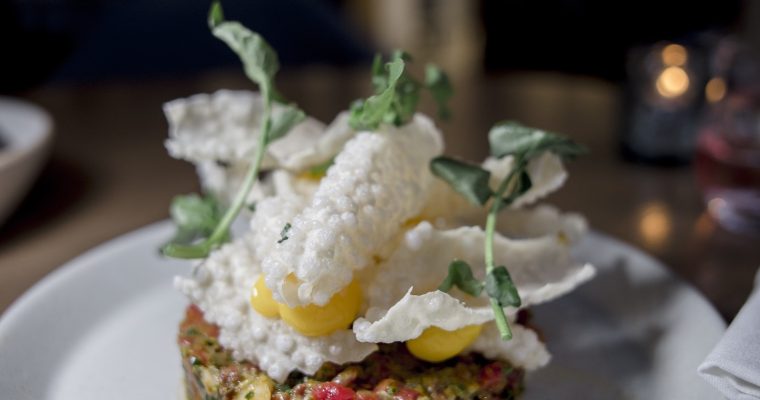
For the apps section, Miku brought the power of aburi pressed sushi and mini-chawanmushi cups, while Littlejohn’s expression came through the strongest with experiences like raw veggies in a soil-like onion pesto, a Viet-style veggie wrap with ultra fresh garden greens, and a lamb tartare on slavic beet and latke bed. (very creative!)
Mains bounced back and forth between the heavy hitting culinary teams, starting off with chunky lamb and ham terrine on a St. Tropez-style salade with a creamy remoulade. Then Miku took over with a tender serving of Saikyo miso-marinated sablefish circled by smoky octopus and a puttanesca sauce. (I usually wouldnt eat the skin but this fish was next level.) Team Littlejohn hit back on the next course with a serving of farm-bred Rustic Ranger chicken (a bred with an optimal fat to protein ratio), in a corn soup/succotash sauce. But I would say that Miku won the final round with a cut of ultra tender beef cheek draped with thinly shaved a5 Wagyu serving, in a beef bourguignon-style sauce, accompanied by classic steak house fried onion tempura.
I think dessert was a tie, with a Littlejohn goat’s milk pannacotta with preserved berry compote (the berry’s balanced the goatiness) and Miku’s decadent green tea Opera cake, made from adzuki bean cream, dark chocolate ganache, and Ferrero Rocher-like hazelnut wafer that was hard not to devour in a single bite.
Wow, it’s been a while! I guess my negligence is partly due to the fact that I’ve migrated my writing portfolio to JournoPortfolio, which is an excellent solution for creating and archiving your work as a journalist! I wish that kind of turnkey solution existed …
Montreal’s Naked & Famous selvedge denim gurus resurrect my junior high memories of Street Fighter 2 button mashing with a collaborative capsule collection made in partnership with Capcom. N&F has a storied relationship with Japanese selvedge manufacturers so this makes perfect sense.
Ryu and Guile themed jeans will make their debut end of November featuring “secret handshake” detailing like hadoukens and sonic boom embroidery, heavily detailed vegan-leather patches, illustrated pocket details and a lot more.
Ryu Hadoken Slub Stretch Selvedge Denim available in Super Skinny Guy, Weird Guy, and Easy Guy fits. Guile Sonic Boom Selvedge Denim available in Super Skinny Guy, and Weird Guy fits. The guys also teased the new SF2 button-up shirts sporting hadoukens and other SF2 characters. Rumour has it that an Akuma fireball version is also on its way, along with several more capsule drops throughout the year.
Check out the vlogcast where all is revealed for all the juicy details on how the collaboration came about, and even more hidden denim details. In case you’re new, Naked & Famous are pioneers in the Canadian selvedge denim scene, known for their low-profile advertising and high-featured products like glow-in-the-dark denim, scratch-n-sniff denim, 24 oz Elephant selvedge and so many other wacky gimmicks that speak directly to my inner denim geek.
Want to know the lay of the land from high tech e-sport meltdowns to beer-soaked nerd caves? Well look no further. Ready Player One! Today’s arcades, or “barcades,” are experiencing a 21st-century renaissance, with venues popping up all over the world, from Taipei to Tokyo …
I was lucky enough to get back to my roots this summer on a fashion contract at Holts where I was assisting on the luxe retailer’s social media, online catalogue as well as their glossy Fall/Winter 2017 book. Check out my profile on the velour, LSD …
Three women dressed in bright pink djallabahs and headscarves ride across the desert in a white jeep. A trio of b-boys in matching blue tracksuits and red fezzes pull their best moves while an older woman watches in a rocking chair.
These are just a few of the scenes from the music video for “Habib Galbi” (Arabic for “love of my heart”), a song by Israeli sister trio A-WA, which currently has over 2.8 million YouTube views and has become the first Arabic-language song to ever hit No. 1 on the Israeli pop charts. The group (pronounced “ay-wah,” which translates to “yes”)—Tair, Liron, and Tagel Haim—sing in an obscure Arabic dialect of their Jewish Yemeni ancestors, infusing hip-shaking folk rhythms and ancient lyrics with an electronic Middle Eastern gypsy beat, or “Mizrahi” sound.
“We confuse the audience in a good way. We make people think and open their ears to realize that situations are not black and white. People can be many things, and that’s the beauty of it,” says Liron, backstage during a recent Toronto concert.
Originally from a small village called Shaharut on the Egyptian border, all six of the Haim siblings fell in love with music at a young age, listening to their parents’ record collection including Bob Marley, 70s and 80s prog rock, and gypsy music. They were also drawn to the Yemenite folk cassettes they heard when they visited their grandparents.
The lyrics of that folk music were preserved, but other elements were not—for example, the call-and-response aspect of Yemenite songs, which is is passed down orally from one generation to another. Recovering this aspect of the music was a challenge that Liron, who completed her bachelor’s degree in ethnomusicology, readily accepted. She eventually discovered archival references from 45s recorded in the 1950s and 1960s.
“There’s a beautiful music scene where young musicians like us are going back to their Eastern roots, be it Egypt or Iraq—they want to bring this sound of their Jewish ancestry,” says Liron. “We are a different generation. We don’t feel suppressed, as our grandparents did as refugees. Our generation is more open and curious about our family roots.”
While this style was shunned during the country’s formative years in the 1940s, today it’s enjoying a popular revival on the streets of Tel Aviv. A-WA’s songs come from a woman’s perspective, touching on social issues that are timeless, but adapted for a modern approach with an element of street poetry. “It’s very direct and daring, like from the streets, with a Yemeni sense of humour. Full of groove,” says Tair.
“Habib Galbi,” which has been remixed by artists including French duo Acid Arab and Polish producer P.A.F.F., has received frequent radio play and can often be heard at restaurants, weddings of all cultures, and other celebrations.
It’s not just Middle Eastern audiences who are paying attention either—the trio just wrapped up their first North American tour, including shows at this year’s SXSW (“It was crazy, like a jungle!” says Tair enthusiastically). In Austin, they were also interviewed by none other than former American Idol judge, producer, and musician Randy Jackson.
During interviews they’ve clearly accepted their roles as cultural ambassadors, often accidentally speaking in unison, while their live shows capture their powerful harmonies and subversive lyrics. Tomer Yosef of well-known Israeli group Balkan Beat Box(no strangers to colliding genres themselves), has been accepted into the Haim family as a true brother and has been handling their production work. The full album which has been out in Israel since 2015 will be coming to North America this summer, while their Habib Galbi EP has just seen the light of day across the continents.
“People are curious about our identity and the small desert town in southern Israel where we are from,” says Tagel. “Yemeni music is something very special.”
Canadian Headliners Spread the Spirit of EDC MAR 11, 2016 / Jesse Ship With several editions across the US and a growing expansion into international lands, EDC has become a truly global phenomenon in its 20-year existence. The festival attracts ravers from all over the world, so it …